
Growing your social media following is exciting, but follower numbers alone won’t grow your business. For social media to become a valuable marketing channel, you need to turn some of that attention into action.
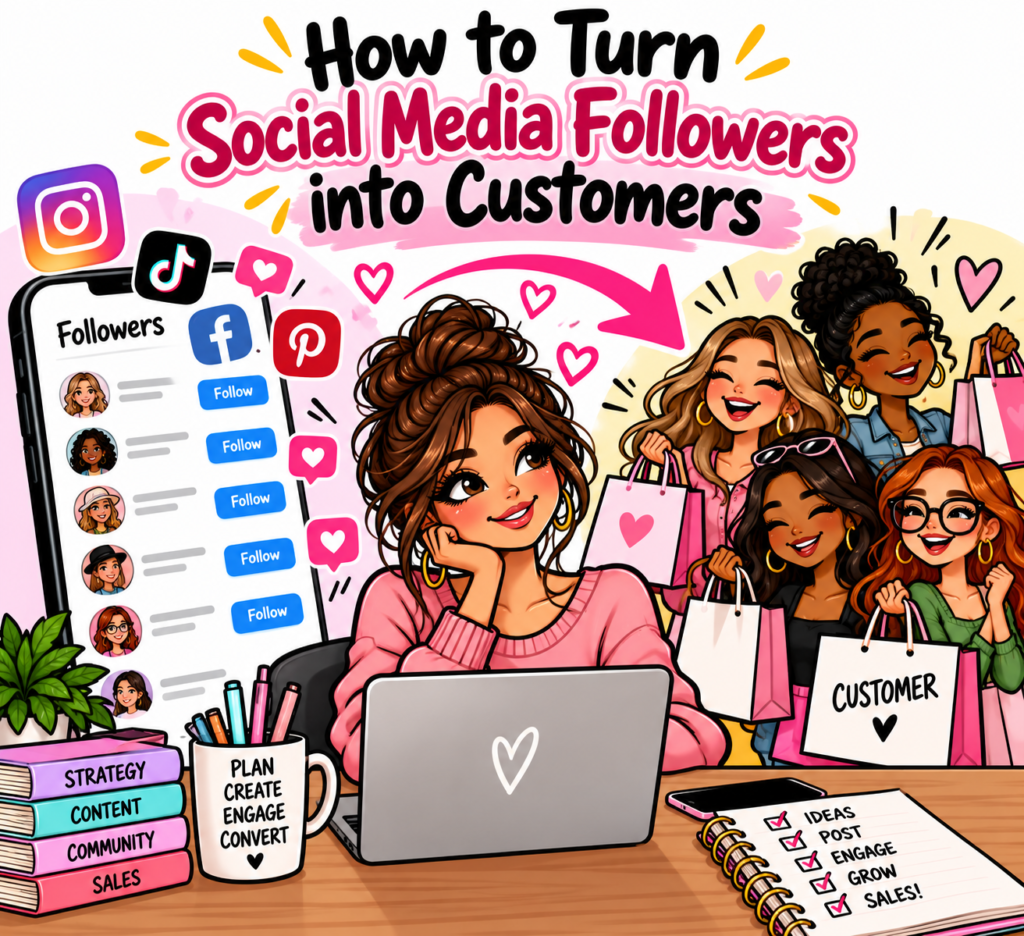
Whether you run an online shop, freelance business, café, creative brand or local service, your social media followers can become potential customers. The challenge is giving them a reason to move from scrolling through your content to visiting your website, browsing your products or making a purchase.
You don’t necessarily need thousands of followers to make social media marketing work, either. A smaller, engaged audience that genuinely cares about your business can be far more valuable than a huge following that rarely interacts with your content.
So, how do you turn social media followers into customers? Here are some strategies small businesses can use to convert followers into paying customers.
Understand who your social media followers are
Before trying to sell to your audience, you need to understand who they are.
Think about the type of person your business is trying to reach. What are they interested in? What problems are they trying to solve? Why might they choose your product or service?
Your social media analytics can provide useful clues about your existing audience. Depending on the platform, you may be able to learn more about follower demographics, locations and how people interact with your content.
You should also pay attention to the posts generating the most comments, shares, saves, clicks and enquiries.
This can help you understand what your followers actually want rather than simply guessing.
The better you understand your target audience, the easier it becomes to create social media content that can move potential customers towards a purchase.
Make it clear what your business offers
Someone discovering your social media profile shouldn’t have to investigate to understand what you sell.
Your profile should quickly communicate what your business does and why someone should be interested.
Review your social media bio and ask yourself whether a new visitor could understand your business within a few seconds.
For example, instead of a vague description such as:
Making life a little sweeter.
A bakery might use:
Independent Bristol bakery creating handmade celebration cakes, brownies and treats.
The second description immediately provides useful information about the business, its products and its location.
Clear descriptions can also support social media SEO by including relevant keywords that potential customers might use when searching for businesses, products and services.
Create content for potential customers
Not every social media post needs to sell something.
In fact, constantly asking your followers to buy your products can quickly become repetitive.
Instead, create a mixture of content that educates, entertains, informs and promotes.
A small skincare company, for example, could create content about skincare routines, ingredients, frequently asked questions, product demonstrations, customer reviews and behind-the-scenes manufacturing.
Within this content, there are plenty of natural opportunities to introduce products without every post becoming an advertisement.
Think about the questions potential customers might ask before making a purchase and turn those questions into content.
Useful social media content can build familiarity with your business while giving followers more reasons to return to your profile.
Show your products in action
Don’t simply tell followers what your product does. Show them.
Product demonstrations can help potential customers understand what they’re buying and how it could fit into their lives.
If you sell clothing, show different ways an item can be styled. If you make candles, create videos showing them within different rooms. If you’re a photographer, share examples of your finished work alongside behind-the-scenes content from shoots.
Service businesses can do this too.
A graphic designer could share before-and-after branding projects, while a personal trainer could demonstrate exercises or explain their coaching process.
Showing your product or service in context can help bridge the gap between someone casually following your business and imagining themselves as a customer.
Use clear calls to action
Sometimes, the easiest way to encourage followers to take action is simply to tell them what to do next.
A call to action, or CTA, gives your audience a clear next step.
Depending on your business, this could be:
- Shop the collection
- Visit our website
- Book an appointment
- Join our mailing list
- Discover the full range
- Read the latest blog post
- Download the guide
- Find out more
- Pre-order now
- Get your tickets
Your call to action should match the content.
If you’ve posted a video introducing a new product, directing people to view that product makes sense. If you’ve shared useful advice from a longer article, you could encourage followers to visit your website to continue reading.
Don’t assume people will automatically know what you want them to do.
Make your social media links easy to find
You’ve convinced someone to visit your profile. They’re interested in your business and want to find out more.
Don’t make the next step difficult.
Your most important links should be easy to access from your social media profiles.
A Bio Link can help businesses bring several destinations together on one landing page. Instead of choosing a single destination, you could direct followers towards your online shop, website, newest product, latest content and other social profiles from one place.
This can be particularly useful when you’re promoting several things at once.
Whatever approach you choose, regularly check your profile links. Outdated links, broken pages or links to promotions that ended months ago can create unnecessary barriers between followers and potential purchases.
Build trust before expecting a sale
People aren’t necessarily going to buy something the first time they see your business on Instagram or TikTok.
They might discover your profile, watch a few videos and continue scrolling.
A few days later, they might see another post. Eventually, they may visit your profile, read customer reviews and click through to your website.
This is why consistency matters.
Regularly creating useful social media content gives potential customers more opportunities to become familiar with your business.
Trust can also be strengthened by sharing things such as customer reviews, testimonials, product demonstrations, behind-the-scenes content and answers to frequently asked questions.
The aim isn’t simply to gain someone’s attention once. It’s to build enough familiarity and confidence that your business comes to mind when they’re ready to buy.
Use social proof
Customers can be some of your best marketers.
Reviews, testimonials and user-generated content can show potential customers that real people already use and enjoy your products or services.
If someone shares a photo or video featuring your business, consider asking whether you can repost it.
You could also encourage customers to tag your business when sharing their purchases on social media.
For service-based businesses, testimonials can be particularly powerful. Sharing a client’s experience can help potential customers understand the results or experience they might receive.
Social proof can reduce some of the uncertainty that naturally comes with buying from a business for the first time.
Don’t ignore your comments and messages
Social media is supposed to be social.
If potential customers ask questions about your products, availability, delivery or services, responding can make the difference between gaining and losing a sale.
Try to respond to genuine comments and direct messages within a reasonable timeframe.
Your replies are also part of your brand.
Being helpful and approachable can create a positive experience before someone has even become a customer.
You may also notice the same questions appearing repeatedly. If so, consider turning them into social media posts, videos, FAQs or website content.
Give followers a reason to act
Sometimes your audience needs a reason to move from considering a purchase to actually making one.
Product launches, limited collections, seasonal campaigns, events and genuine promotions can all provide natural opportunities to encourage action.
For example, you might promote:
- A new product launch
- Limited stock
- Seasonal products
- Pre-orders
- An upcoming event
- A genuine limited-time offer
However, urgency should be genuine.
Constantly telling customers that something is their “last chance” when the offer returns every week can damage trust.
Use urgency when there really is a reason for someone to act now rather than later.
Create content for different stages of the customer journey
Not every follower is at the same stage.
One person may have discovered your business five minutes ago, while another may have followed you for six months and already be considering a purchase.
Your social media content can target these different stages.
For people discovering your business, create entertaining, educational or searchable content that introduces your brand.
For followers considering a purchase, share demonstrations, FAQs, comparisons, reviews and testimonials.
For people ready to buy, make your calls to action, prices, product information and links easy to find.
Thinking about the customer journey can help you create a more balanced social media content strategy rather than focusing entirely on either gaining views or generating immediate sales.
Optimise your content for social media search
Social media platforms increasingly act as search tools.
People search for restaurants, products, tutorials, reviews, recommendations, local businesses and services directly through social media.
Small businesses should therefore think about social media SEO when creating content.
Use relevant keywords naturally within your profile, captions, video titles and on-screen text.
For example, a wedding photographer in Cornwall could use phrases such as “Cornwall wedding photographer” when appropriate rather than relying entirely on vague captions.
Hashtags can also provide additional context, but they shouldn’t replace clear descriptions and relevant keywords.
Think about what your ideal customer might search for and create useful content around those searches.
Don’t focus entirely on follower numbers
A large social media following can look impressive, but it doesn’t necessarily translate into customers.
Imagine two businesses.
One has 50,000 followers but receives very few website clicks or purchases.
The other has 3,000 followers who regularly interact with posts, visit the website and buy products.
Which audience would you rather have?
For most small businesses, the second is considerably more valuable.
Instead of obsessing over follower numbers, pay attention to whether your social media activity is contributing to meaningful business results.
Track your social media traffic
If you’re using social media to grow your business, you need to understand what happens after someone clicks your link.
Track the traffic you’re sending from different social networks and campaigns wherever possible.
Smart Links can be useful when sharing a destination across different campaigns, while link analytics can help you understand how people are interacting with what you share.
For example, you might discover that Instagram sends considerably more clicks than another platform, or that a particular campaign generates unusually high engagement.
This information can help you decide where to spend your time and what type of content to create next.
Rather than simply asking, “How many followers did we gain?”, start asking, “What did those followers do?”
Keep the buying process simple
Every unnecessary step creates another opportunity for a potential customer to leave.
Imagine someone watches your TikTok, visits your profile, clicks your link and decides they want to buy your product.
They shouldn’t then have to search through five different pages to find it.
Try the customer journey yourself.
Start on each of your social media profiles and attempt to complete the action you want your followers to take.
How many clicks does it require? Is it obvious where to go? Does the page work properly on mobile? Is the product easy to find?
Removing even small amounts of friction can make your social media marketing more effective.
Turn followers into a community
Your social media audience shouldn’t feel like a collection of numbers.
Ask questions, respond to comments, share customer content and involve your followers in your business where appropriate.
You could ask followers which product they’d like to see next, show behind-the-scenes decisions or invite feedback about an upcoming launch.
This two-way interaction can help people feel more connected to your business.
An engaged community can also lead to repeat customers and recommendations, rather than simply one-off purchases.
Focus on customers, not just followers
Turning social media followers into customers doesn’t happen through one viral post or clever sales trick.
It comes from creating useful content, reaching the right audience, building trust and making it incredibly easy for interested followers to take the next step.
Optimise your profiles for social media SEO, demonstrate the value of your products or services and use clear calls to action. Make your important links easy to find and track which social media platforms and campaigns are actually driving traffic.
Most importantly, don’t judge the success of your small business on social media purely by the number beside your follower count.
Ten followers who become loyal customers could be far more valuable to your business than thousands who simply keep scrolling.