Once your single is out, another email saying “my new song is out now” may have little to offer a fan who has already listened. A follow-up works better when it gives them a fresh reason to return.
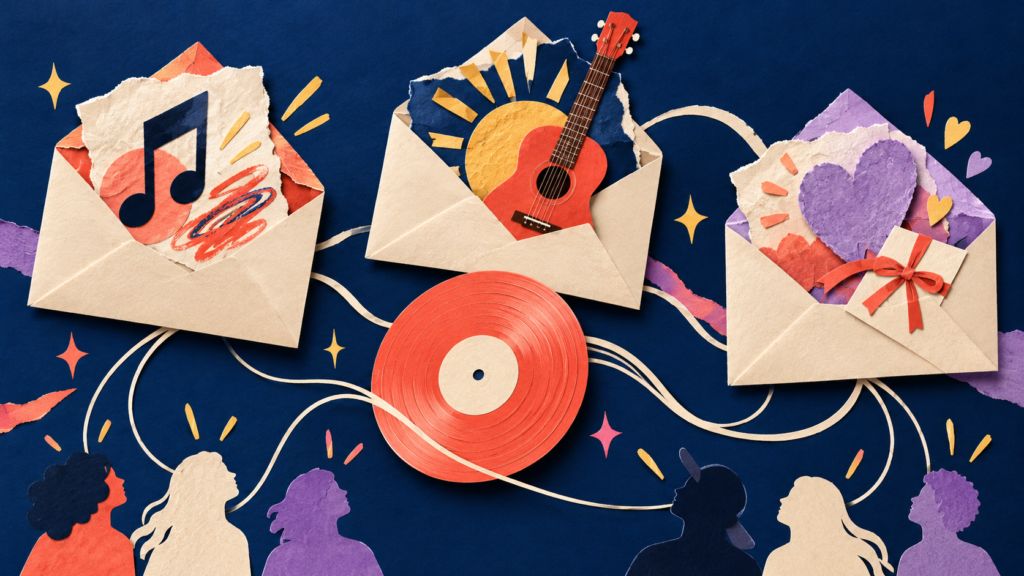
These music release follow-up email templates cover three useful angles: the story behind the song, a different version and a thank-you. Choose the messages you can support with something real. You do not need to send all three.
Start with the right audience
Send marketing messages to people who have agreed to receive them through your chosen setup. A purchase or a saved contact is not, by itself, a reason to assume someone wants a promotional sequence.
You may not know exactly who has listened. If you cannot verify that action, avoid opening with “You streamed my song yesterday”. Write for people familiar with the release without pretending to know their individual behaviour.
PUSH’s guide to email marketing for musicians covers the broader relationship. The examples below focus on what you can share after the launch announcement.
Email 1: share the story behind one detail
Subject: The line that started [Song]
Hi [Name],
[Song] began with [a specific lyric, moment or musical idea]. I kept coming back to it because [a short, honest explanation].
One detail you might hear differently now is [describe the detail]. It changed from [earlier idea] to [finished choice] while we were making the track.
If you fancy another listen with that in mind, you can find the song here: [listening link].
Thanks for spending time with it,
[Artist]
Keep this message centred on one detail. You do not need a dramatic origin story; a useful observation about the recording can be enough. Remove the earlier-version sentence if the song did not develop that way.
Email 2: offer a different way to hear it
Subject: A different version of [Song]
Hi [Name],
We recorded [an acoustic/live/alternative version] of [Song], and it brings out [a specific difference in the performance].
You can [watch/listen to] it here: [version link].
The original recording is also there if you want to compare the two.
I would love to hear which detail you noticed first.
[Artist]
Only use this message when the alternative version is ready and the link delivers it. If it is a video, say “watch”. If the page also includes the original, label both versions clearly.
You can use a music Smart Link to organise the relevant destinations. Do not make readers search a general profile page for the version promised in the email.
Email 3: thank fans with something specific
Subject: A small thank-you for supporting [Song]
Hi [Name],
Thank you for being part of this release. [Add one true observation about the experience, without inventing numbers or feedback.]
I have put together [a lyric note, behind-the-scenes clip or other finished extra] to share a little more of the process. You can find it here: [link].
There is [state any access requirement clearly].
Thanks again,
[Artist]
Make the access wording accurate. If you use a Reward Link for bonus content, explain the requested action before somebody opens it. If the extra is directly accessible, do not imply there are conditions.
Decide the timing from the content
Space the messages according to what you have to share and what your subscribers expect. A story can follow the announcement; a live version can arrive when it is published. A thank-you should feel connected to a real moment rather than an automated deadline.
If you are sending these through Broadcasts or another email tool, check the current sending and scheduling options in that tool. The templates do not depend on a particular automation feature.
Use PUSH’s guide to writing useful email subject lines to adapt the subjects to your voice. The subject should accurately describe the message, without manufactured urgency.
Give each email a useful job
Check the destination, send yourself a test and read it on a phone. Track the relevant clicks or replies available in your email tool, while remembering that a link click does not establish a completed listen.
Start with one follow-up you can make worthwhile today. A specific story or finished performance gives fans a reason to return without repeating the release announcement.